
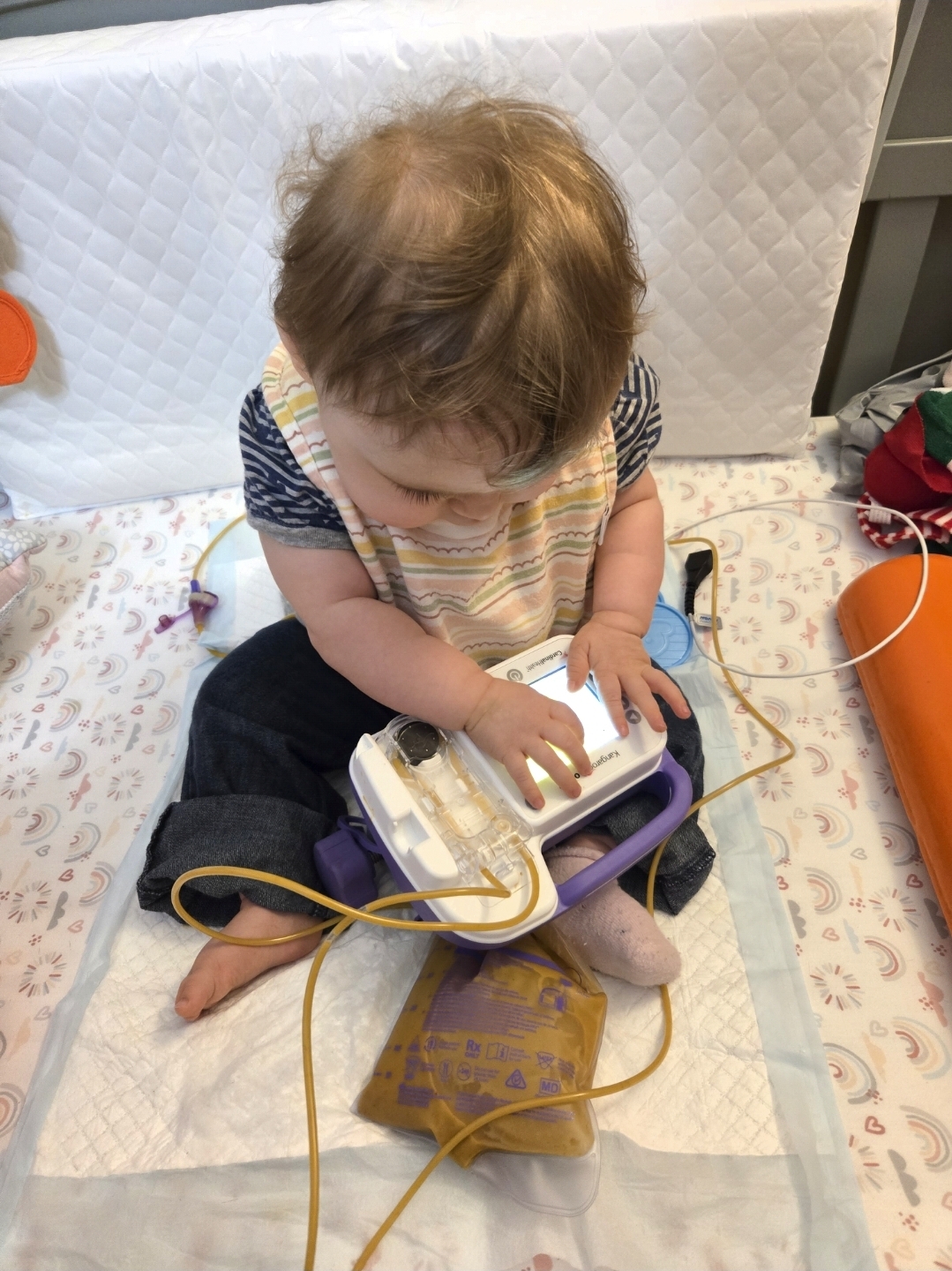

Morning: Starting the Day Together
If your child relies on enteral feeds, mornings often come with their own rhythm. For Jenna, the day starts with disconnecting her overnight setup, giving her medications, and flushing behind each med. It becomes a small sequence you run through without even thinking — meds, flush, check the site, and make sure everything looks comfortable for your child.
Next comes the first feed of the day. Some families pour formula into a bag, some draw blends into syringes, and some prep a pump for continuous feeds. No matter the method, the basics stay the same: gather what you need, prepare the feed, and get things moving. Before long, this part of the morning feels just as normal as making breakfast for any toddler.
Supply Spotlight:
Feed bags — 30 per month • changed daily
2×2 split gauze — 1 box per month • used daily around the stoma
Heading Out for the Day: What Travels With Us
Just like airway care doesn’t pause when you leave the house, enteral needs don’t either. Early on, it can feel like you’re packing for a small road trip every time you leave the driveway. Over time, though, you learn exactly what has to come with you.
Our “out-the-door” checklist usually includes current and spare extension tubes, flush syringes, extra formula or food, water, a spare feed bag, the pump’s charger, a cooler bag, our feed pump holder, and the spare g-button – even though my daughter currently has a gj. We also keep a small backup kit in the car because spills, accidental disconnects, and mystery alarms tend to happen in the most inconvenient places. We’ve handled emergency G button reinsertion, mid-feed extension swaps, and more than one “carseat got fed instead of the child” incident.
Preparation turns stressful moments into manageable ones — and eventually, these routines become second nature.
Supply Spotlight:
G or J extensions — 4 per month • changed weekly
Transition adapter (female ENFit) — 4 per month • only needed when using slip-tip syringes with enfit extensions
Syringes — 6 per month for meds/flushes, about 30 per month if syringe-feeding
Tape — 3 rolls per month • for securing tubing, taping extensions, and general emergencies
Keeping the Feeding Routine Running Smoothly
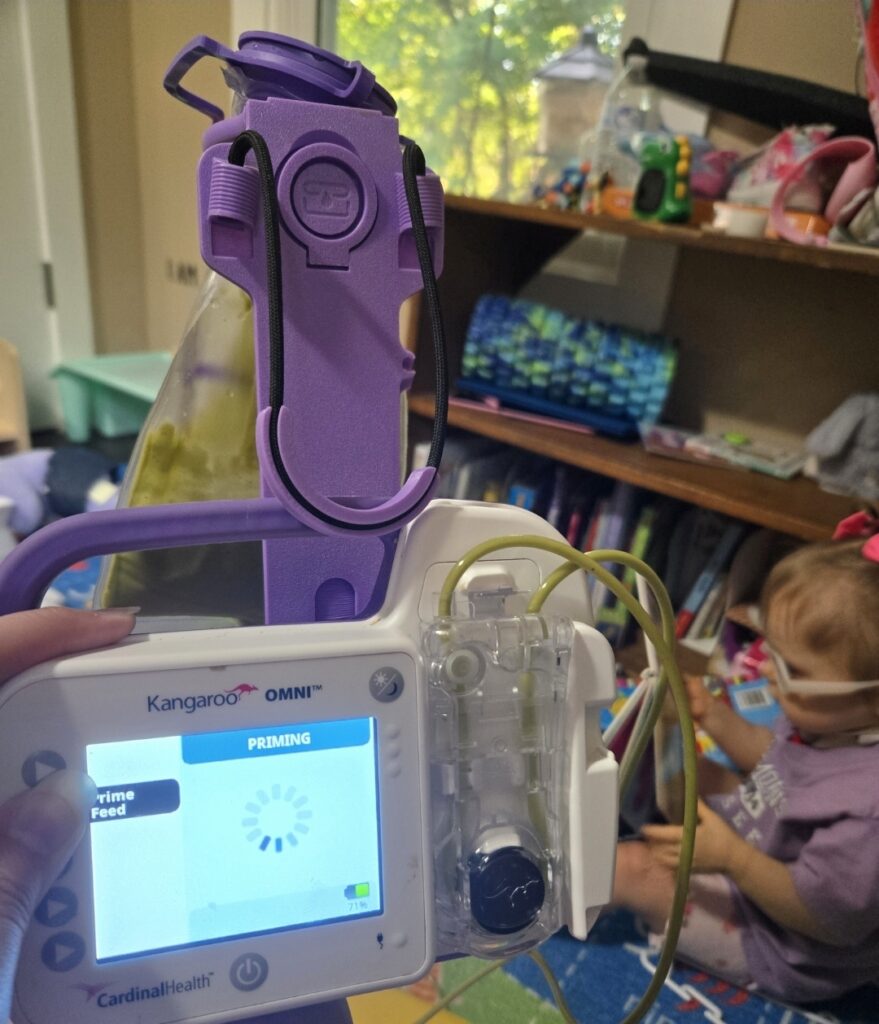
Enteral supplies may not hum along like a ventilator, but they still rely on consistent upkeep. Weekly extension changes help prevent clogging and bacteria buildup. Daily bag changes keep feeds flowing smoothly. And protecting the stoma with gauze and barrier cream can make all the difference in comfort.
Families become surprisingly good at spotting small shifts — a tube that’s starting to feel sticky inside, a bag that alarms more than usual, a little redness that hints it’s time for new gauze. These clues become familiar, and you start to understand the equipment the same way you understand your child: through patterns, subtle changes, and practice.
Evening: Medication, Cleaning, and Resetting the Day
Evenings are usually when everything settles. For tube-fed kids, this can mean flushing after the last feed of the day, switching out the gauze, prepping an overnight feed, or loading tomorrow’s supplies. Some families do their weekly extension changes in the evenings because their child is calmer, others in the morning — or in our case, no specific time of day (just every Monday), whenever it fits.
By this point in the day, you’re not just maintaining equipment. You’re setting up for the night and for tomorrow to run smoothly. And as the routine becomes familiar, evenings feel less like medical care and more like simple preparation for rest.

G Buttons: The Non-Negotiable Backup
Some enteral supplies stay in the background until the moment you absolutely need them — and the G button is one of those. Routine checks and scheduled changes help prevent problems, but having a spare button that travels with you is essential.
If your child has a G tube or GJ tube, make sure GI sends an order for a backup button. If the button ever comes out, this is what you insert to keep the stoma open until you get medical care. It is one of the most important enteral items you will ever store in your supply cabinet.
Routine changes are usually done every 3 months, but some doctors suggest longer, though malfunctioning buttons can be replaced sooner. For us, even with routine changes, we still have to call to request the replacement be shipped.
Supply Spotlight:
G button — 1 • changed every 3+ months based on your child’s GI plan
Ending Thoughts
When you walk through a day piece by piece, enteral supplies start to feel less overwhelming. You begin to see how they fit into everyday rhythms, just like airway equipment does. What once looked like a long list turns into manageable steps — not because the supplies become simpler, but because you gain confidence.
Every family’s enteral supplies and routine will look different, as it should. But breaking it down into moments helps new families picture what life at home can look like: structured, adaptable, and grounded in purpose rather than fear.